7 min read.
Padel court authorizations: everything you need to know
Due to its increasing popularity, padel is attracting more and more investors to build new courts and facilities dedicated to the sport. But what permits are needed to build a padel court? We explain in this article.
Increasingly popular in Italy but not only, padel is a sport that is attracting more and more investors in recent years. In fact, there are numerous padel courts and facilities built all over the territory within a short period of time.
If you, too, are interested in building a new padel court, in this article you will find out all the necessary permits and rules you need to comply with in order to get the green light to build.
Born in the early 1970s in Mexico, padel (or paddle) has now caught on all over the world, including our country. The official presentation of the sport took place in May 1991, when a paddle court was opened at the Bologna Fairgrounds during the Sport Show event, a court on which representatives from Spain, Italy and Argentina clashed.
In Italy it is then officially recognized by CONI and included, in 2008, in the FIT (Italian Tennis Federation).
We see in this article:
- What permits are needed to build padel courts
- Permits for outdoor padel courts
- Permits for indoor padel courts
- Italgreen's padel courts
What permits are needed to build padel courts
To avoid incurring penalties or legal problems related to the installation of a non-compliant field, it is essential to know all the permits needed to build padel courts while complying with current regulations. There are several steps and considerations to take into account when deciding to build a field, whether indoor or outdoor.
Below are some useful pointers:
First of all, it is important to know that padel courts fall into the category of "simple construction," which entails a set of well-defined permitting procedures.
To begin with, it is necessary to go to the appropriate municipal office to apply for a declaration of zoning eligibility for the installation.
Once this declaration has been obtained, a feasibility study is carried out to verify the concrete possibility of building the field in the identified area. If the feasibility study is successful, a building permit can be applied for.
At this point, it will be important to determine whether it is an indoor or outdoor padel court, as the required procedures and permits may vary depending on this feature.
Let's look in detail at some key aspects:
Feasibility study
The feasibility study is an essential step in understanding the real possibility of installing a padel court in the chosen location. It consists of a preliminary analysis conducted by licensed professionals, such as geologists, engineers, and architects, who check several aspects of the project.
The first phase involves the geological report of the site, carried out by a geologist to assess the characteristics of the soil and its suitability to support the concrete foundation of the court.
The main elements that are analyzed during the feasibility study are:
- The conformation and stability of the ground, to ensure an adequate structural base for the camp.
- The presence of any environmental or landscape constraints that could affect the construction.
- The verification of the accessibility of the area, to ensure easy transportation of materials and execution of the work.
- The analysis of local zoning regulations, to understand what permits are needed.
Next, the appointed professional will need to identify what municipal permits are required to proceed with the construction of the padel court. These permits may vary from municipality to municipality and depend on the local regulations in force at the time of the application.
Therefore, it will be up to the licensed professional to select the appropriate permit, which could be SCIA (Segnalazione Certificata di Inizio Attività), CILA (Comunicazione Inizio Lavori Asseverata), or PdC (Permesso di Costruire), among others. In addition to municipal authorizations, additional documentation may be required to be submitted to other relevant bodies, such as the Civil Engineers, the Basin Authority, or the Park Authority, if the field is located in areas subject to specific constraints.
Finally, after obtaining all necessary clearances,a structural design must bemade, which will be accompanied by a seismic deposit, if required by local regulations. Italgreen can assist the appointed technician in this phase by providing all the necessary documentation for the sizing of the slab and the structural design of the field.
Permits: SCIA, CILA, and Building Permit (PdC)
The choice of the type of permit needed to build a padel court depends on the specifics of the project and the zoning regulations of the municipality where the construction site is located. The SCIA, for example, is a simplified procedure that allows work to begin immediately after the submission of the documentation, while the CILA is a communication sworn by a technician for interventions of minor impact. In cases where the work to be carried out is more complex or involves significant structural changes, it will be necessary to apply for a PdC, which requires a longer waiting time to obtain.
In all cases,it is essential to turn to a licensed professional who can manage the entire bureaucratic process and ensure that all the paperwork is carried out correctly. Italgreen can offer support at every stage of the authorization process, providing materials and documentation necessary to start the procedures. In addition, it is always recommended to rely on an engineering firm in the area that is familiar with local regulations in detail and can guarantee complete assistance from the design phase until all necessary permits are obtained.
In this way, it will be possible to build a padel court in full compliance with current regulations and zoning provisions, ensuring a safe, legal and quality result.
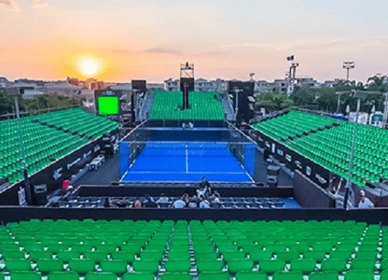
Permits for outdoor padel courts
In case you decide to build an outdoor padel court, it will first be necessary to notify whether it is a padel court made out of an existing installation or whether it is a completely new construction.
In general, the permits required in this case are less than for an indoor court, as the construction turns out to be less complicated.
In particular, the controls to be carried out are of the type:
- Urban planning, thus related to the physical space in which the installation is to proceed;
- Acoustic, thus relating to any noise from the installed field;
- Landscape, i.e. relating to the context in which the field is placed. Information should be provided here regarding all geometric, aesthetic and functional aspects of the field, as well as geological suitability;
- Plant-related, thus relating to the safety of electrical and gas installations.
Permits for indoor padel courts
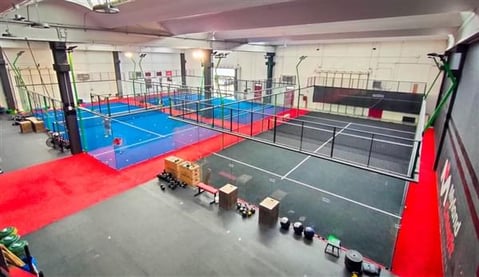
As for indoor courts , however, the elements to be analyzed are:
- Intended use of the building and compatibility of the project with the area in which it is to be built;
- Urban zone of reference;
- Volumetry of the field;
- Urban constraints;
- Suitability of the land by geological survey.
Once all these approvals have been obtained and the construction of the padel court has been completed, testing will be required.
This step covers both outdoor and indoor courts and is used to test the safety of the facility. Since it is in fact a construction intended to accommodate people, it is essential to make sure that the facility does not pose any health risk to those who attend it.
Once this last step has been passed, a certificate of fitness will be issued, a document that authorizes access to the building and frees the owner from any legal risk related to any construction problems.
Italgreen's padel courts
Whether you want to build an outdoor or indoor padel court, italgreen can help you in building a durable, quality structure.
We have designed specific padel turfs that can perfectly facilitate athletes' play and performance:
 Padel Pro: this is the official turf of the FIP ( International Padel Federation), in fact it guarantees the highest quality in terms of comfort and aesthetics. Made of 10 mm textured polyethylene fibers, the special feature of this synthetic turf is its resistance to discoloration from UV rays and frost. It also possesses excellent elastic memory that ensures its return to upright position after being walked on.
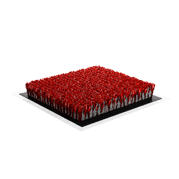 Padel Fib: This turf stands out for the maximum speed of play and the best lateral glide it can provide. It is a type of synthetic grass with a height of 12 mm that is very resistant to discoloration and frost. Also in this case
the high elastic memory is able to guarantee an immediate return of the fibers to an upright position after treading.
Once you have chosen your preferred synthetic turf for your padel court, Italgreen also provides innovative iron structures made by a state-of-the-art process of hot-dip galvanizing and heat-cured powder coating, which are not subject to deterioration and structural failure.
In addition, our iron courts:
- Require no maintenance;
- Resist waterspouts, fire and rust;
- They are fully compliant with the specifications of FIP and FIT.
Need more information about permissions to make padel courts?