Padel tennis court size: the official measurements
What are the dimensions of a padel court? To answer this question we need to refer to what is established by the International Padel Federation (FIP), which is responsible for regulating all the official padel tennis court size and measurements. Let's find out together.
In this article we see:- Padel court dimensions: all the measurements
- Why install a paddle court?
- The features of Italgreen paddle courts
- Italgreen, your trusted partner
- FAQ
Padel court dimensions: all the measurements
The International Padel Federation (FIP) is the official body responsible for determining the rules of the game and the structural parameters every court must meet, including the padel court size.
According to FIP regulations, the padel tennis court dimension are as follows: he court is rectangular, measuring 10 meters in width and 20 meters in length, with a tolerance of 0.5%.
Including the surrounding marginal areas, the overall padel court measurements amount to approximately 23 m x 13 m.
Beyond the playing surface itself, several additional measurements are required to ensure full compliance with FIP standards:
- Wall height: 3 meters;
- Fence height: 4 meters;
- Net length: 10 meters;
- Net hight: 88 cm in the middle and 92 cm at the ends;
- Distance between the net and the side setback lines: 6.95 meters per side
Indoor padel courts - height and characteristics
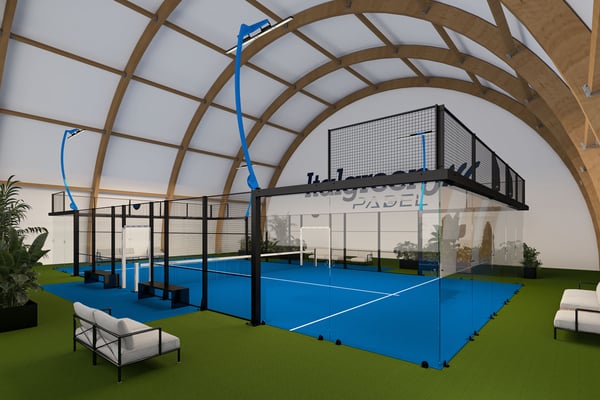
In the case of covered (indoor) padel courts, in addition to the horizontal dimensions, it is essential to consider the vertical development of the structure. According to International Padel Federation (FIP) guidelines, the minimum clear height from the playing surface to any element (such as the ceiling or lights) must be at least 6 meters over the entire surface of the court, without any obstruction. For newly built facilities, the FIP recommends an increased minimum height, i.e. 8 meters, always free of elements that may interfere with play.
The horizontal dimensions remain identical to those of an outdoor court: 20 × 10 m for the playing court, up to about 23 × 13 m considering the marginal areas. This "vertical clearance" is crucial to allow high shots such as bandeja or smash without the risk of interference or obstruction, and to ensure the regularity and homologation of the court for official competitions.
| Measure | Outdoor court | Indoor court |
|---|---|---|
| Field length | 20 m | 20 m |
| Field width | 10 m | 10 m |
| Overall dimensions (with marginal areas) | 23 × 13 m approx. | 23 × 13 m approx. |
| Minimum height | - | 6 m |
| Recommended height (new plants) | - | 8 m |
In addition to having to strictly adhere to these measurements, it is essential that paddle courts be constructed with specific materials as this element can also influence playing performance. On the choice of material depends, for example, the smooth bounce of the ball, which does not occur in wire mesh areas.
Padel court size: single vs. double - what changes
Originating as a couples sport, single paddle is not yet regulated in the official circuits, although it can be played at the amateur level. The main difference between single paddle and double paddle concerns the size of the court. The length is the same for both, but the width of the court for single is 6 meters, while for doubles it is 10 meters. The rules of the game remain the same in both modes, including the height of the net and side walls, as well as the general rules. The placement of the service line also does not change.
| Length | Width | Maximum number of players | |
| Single paddle court | 20mt | 6mt | 2 |
| Double paddle court | 20mt | 10mt | 4 |
Read more: Padel courts: advantages, construction and installation
Single paddle is particularly suitable for those who prefer to play without a partner, similar to single tennis. Not everyone appreciates the presence of a teammate, preferring instead to rely on their own skills. Although the size of the single paddle court is smaller than in doubles, the physical exertion is generally greater, since one has to cover the entire court alone. It should be considered that in single paddle it is difficult to execute volley shots such as volleys, which are very spectacular in doubles play. This is because going to the net in single paddle requires you to cover the 6-meter width of the court by yourself.
Why install a paddle court?
As we have seen, in addition to having to pay attention to the size of the paddle court, there are several technical accuracies to take into account regarding the sport. The main ones include, for example, the characteristics of the net and walls, the lighting of the court, and, of course, the quality of the playing surface .
Although the situation may initially appear complicated, the advantages of installing a paddle court are numerous, here are the main ones:
- A paddle court is very durable; in fact, its lifespan can range from a minimum of 10 years to a maximum of 20;
- It takes up about a third of the space of a tennis court. This means that, for the same amount of land, it is possible to have more matches played at the same time, thus achieving an increase in revenue;
- The maintenance required is really minimal, which makes it possible to significantly reduce maintenance costs;
- The possibility of making the equipment available for rent is an additional form of revenue.
We have talked about durability and minimal maintenance of paddle courts. Obviously, these conditions depend greatly on the quality of the materials used and the attention that is paid to every detail during installation. This is why Italgreen is the winning solution for the construction of an excellent paddle court.
Read also: Panoramic padel court
Italgreen padel courts: materials and technical specifications
Unlike standard steel structures prone to oxidation, the iron used by Italgreen undergoes a hot-dip galvanising process followed by heat-cured powder coating - a two-stage treatment that results in a court built to last.
Every Italgreen court is::
- Fully compliant with FIP and FIT specifications;
- Anti-corrosion resistant, including in coastal salt-air environments;
- Low maintenance by design;
- Fire and tornado resistant - suited to areas with extreme weather conditions;
- 100% Made in Italy, with prompt delivery times.
Italgreen, your trusted partner in building paddle courts of all sizes
Italgreen stands as a trusted partner in the construction of single and double paddle courts. We support you throughout the entire phase of your project, from feasibility study to after sales:
- Analysis: we study with you the feasibility of the project.
- Design: our team of engineers and architects is always available to offer support in drawing up the design of a paddle court.
- Production: we produce in-house customized products for every need.
- Installation: we install worldwide with our own teams of trained technicians.
- After-sales: we are by your side throughout the life cycle of the field to assist with all needs, service and maintenance requirements.
Submit your project to our team, we will provide a no-obligation consultation!
FAQ
-
What are the official padel court dimensions?
According to the International Padel Federation (FIP), the official padel court size is 20 metres in length and 10 metres in width, with a tolerance of 0.5%. -
What is the difference between padel court size and paddle tennis court size?
Padel and paddle tennis are two distinct sports. A standard padel tennis court size is 20 × 10 m, while a paddle tennis court (played primarily in North America) follows slightly different dimensions - typically 20 × 10 m as well, but with different wall configurations and rules. Always verify which sport and governing body the specifications refer to. -
What are the minimum height requirements for an indoor padel court?
FIP guidelines specify a minimum clear height of 6 metres over the entire playing surface. For newly built indoor facilities, a height of 8 metres is recommended to allow all shot types without obstruction. -
How much space do I need to build a padel court?
Beyond the official padel court measurements of 20 × 10 m, you need to account for marginal areas around the structure. The total area required is 23 × 13 metres. -
What surface is used on a regulation padel court?
FIP-approved padel courts use a synthetic grass surface with specific infill and pile characteristics to ensure consistent ball bounce and player grip.
Make your padel court with Italgreen!