
Padel court construction and installation: the complete guide
Building a padel court is one of the most effective ways for a sports center, resort, hotel or club to open a new revenue stream and attract new members. But getting there means moving through design choices, material specifications, regulations and a construction process that has to be executed correctly the first time.
ON THIS PAGE:
- What a padel court is, and why facilities are building them
- What to decide before you design a padel court
- Official padel court dimensions and structure
- Padel court materials and structural components
- How to build a padel court: the construction process, step by step
- What affects padel court construction cost
- Maintaining a padel court after installation
- Why build your padel court with Italgreen
- FAQ
This guide walks you through every stage of padel court construction and installation, from the initial site survey to the turnkey delivery of the field, so you know exactly what to expect and what to ask your supplier. Whether you're weighing up a new build or a padel construction project on an existing tennis court, the sequence below is the one to follow.
Let's go into detail.
WHAT IS A PADEL COURT, AND WHY BUILD ONE
Padel is a racket sport that combines elements of tennis and squash: it is played in doubles, on an enclosed court roughly a third the size of a tennis court, where the surrounding glass walls and metal fencing are actively used to keep the ball in play. Its appeal lies in how quickly it can be picked up - matches are enjoyable after just a few exchanges, without requiring the physical conditioning or technical skill tennis demands.
For a facility owner, that accessibility translates directly into a business case. Because a padel court is roughly half the footprint of a tennis court, the same plot of land that holds one tennis court can typically accommodate two to three padel fields. Building a padel court on unused or underperforming space is, for this reason, one of the more common ways sports centers, resorts and clubs choose to grow their business today.
The main advantages include:
- Increasing the number of people using the facility, since padel is played in doubles and turns over faster than tennis;
- Diversifying the offer and becoming a more attractive, receptive location;
- Optimizing unused or underused space;
- Extending course and lesson offerings to tennis instructors and coaches;
- Adding a sport that is complementary to, not competitive with, an existing tennis offer.
Italgreen has been building synthetic sports surfaces since 1983 and, thanks to years of collaboration with specialized partners, has developed a full padel court construction service that covers design, engineering and installation. If you're ready to build a padel court of your own, see how we supply padel courts from end to end.
PLANNING AND DESIGNING A PADEL COURT: WHAT TO DECIDE BEFORE YOU BUILD
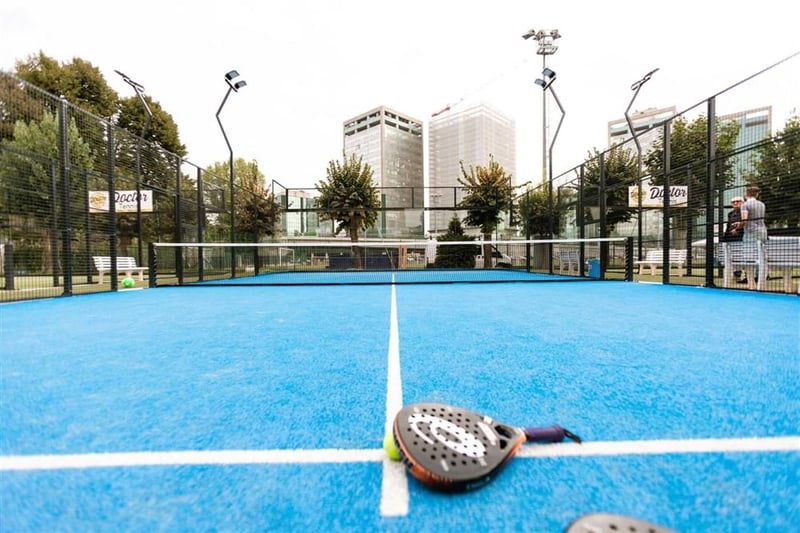
Before any construction work starts, a good padel court design requires a set of decisions that shape the rest of the project, from the materials you specify to the permits you'll need. Getting these right at the planning stage avoids costly changes once the build is underway.
Indoor or outdoor?
Indoor and outdoor padel courts may look similar at a glance, but they diverge on two important points:
- Weather resistance: the climate of your region drives material selection, especially for outdoor courts exposed to heat, cold or moisture. Durability becomes the priority under these conditions.
- Lighting: brightness is essential for both formats, but indoor padel courts can take advantage of energy-efficient LED systems designed specifically for enclosed spaces.
Fixed, mobile or panoramic structure?
Beyond indoor and outdoor, Italgreen offers several structural formats depending on the space and budget available: Mobile and Extreme facilities for flexible or compact installations, and Panoramic Indoor, Panoramic Outdoor, Super Panoramic Indoor and Super Panoramic Outdoor for venues that want maximum visibility and a premium spectator experience.
Terrain and site requirements
Before committing to a site, a few checks prevent costly issues later: ground that's flat, stable and free of rocks or debris; adequate drainage, especially outdoors; enough soil bearing capacity to support the slab and structure without settling unevenly; clear access for construction equipment; and, for outdoor courts, an orientation that limits glare during play. These are exactly what the topographic survey in the construction process below is designed to confirm on-site.
Permits and authorizations
Once the site is confirmed, check the permits required in your area: requirements vary depending on whether the court is indoor or outdoor, and on local zoning and building codes. In most jurisdictions this covers structural and safety certification (addressed later in the construction process through static testing and a certificate of fitness) and, for courts intended to host official matches, compliance with FIP-regulation dimensions and specifications. Our dedicated guide to padel court authorizations covers what to check before you apply.
OFFICIAL PADEL COURT DIMENSIONS AND STRUCTURE
According to the International Padel Federation (FIP), a padel court measures 20 meters long and 10 meters wide - the playing area itself is enclosed by the court's own structure. From a construction standpoint, what actually drives material choices and cost is the overall footprint and the height of the back walls:
|
Element |
Measurement |
|
Court dimensions |
20 m x 10 m |
|
Total playing area |
200 m² |
|
Back wall height (outdoor / panoramic) |
4 m |
|
Back wall height (indoor, central peak) |
8 m, up to 8.90 m |
The net is supported by a metal cable (1 cm in diameter) attached to two side posts, and sits at roughly 0.88–0.92 m high depending on the point measured. In outdoor and panoramic padel courts, back walls typically reach 4 meters; in covered courts, walls usually rise to 8 meters, with a dome or arch-shaped peak of up to 8.90 meters at the center of the structure to optimize strength and load capacity.
PADEL COURT MATERIALS AND STRUCTURAL COMPONENTS
Every padel court, regardless of format, is built around the same core components. The quality of each one determines how the court plays and how long it lasts.
Structure and frame
Italgreen manufactures the court structure - including the frame, net posts, walls and roofing where applicable - in fiberglass, using patented technology. Compared with traditional iron structures, fiberglass does not rust, is resistant to salt corrosion, UV rays and fire, and does not suffer the structural fatigue that shortens the life of metal frames. The result is a structure that requires very little maintenance and holds its aesthetics for years. Structures can also be customized, for example by choosing the color of lights and brackets (total black or flash green).
Floor and playing surface
The floor of a padel court needs hardness, speed and the right roughness to guarantee consistent ball bounce and slide. While treated concrete flooring exists, artificial turf is the preferred surface for both performance and comfort. Turf choice affects the stiffness, softness and speed of the game, so it should be selected deliberately rather than by default.
Italgreen produces two turf lines specifically engineered for padel. Padel PRO is a 10 mm textured polyethylene turf built for comfort and aesthetics, available in blue, red, green and black. Padel FIB is a 12 mm fibrillated-fiber turf built for maximum playing speed and lateral glide, available in blue, red and green. Both use fibers resistant to UV rays and frost, with high elastic memory so the pile returns upright quickly after being walked on.
Walls and fencing
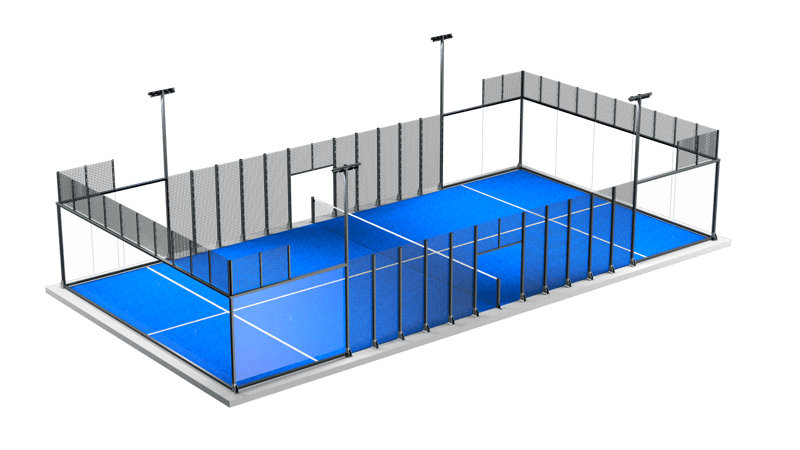
Walls are usually prefabricated structures, especially on fixed installations. Tempered glass is the preferred material: it delivers the correct ball bounce while keeping the court visible from the outside, which matters both for spectators and for the court's role as a visible amenity. Fencing above and around the glass must resist weather and the physical stress of play - zinc or plasticized mesh are the most common choices for durability. Entrances can be delimited with two doors mirroring the fencing, or left open depending on the layout.
Lighting
Lighting is arguably the most technical component to get right: it needs to cover the whole field evenly without dazzling players, which means evaluating fixture type, position and height carefully during design rather than as an afterthought. This is one of the reasons lighting is planned alongside the structural frame rather than added at the end.
HOW TO BUILD A PADEL COURT: THE CONSTRUCTION PROCESS, STEP BY STEP
Once design and materials are locked in, building a padel court follows a defined sequence. Skipping or reordering these steps is the most common reason courts underperform on speed, bounce consistency or durability. Here is the process Italgreen follows on every project.
Site inspection and topographic survey
A comprehensive survey evaluates ground conditions and confirms the site is suitable before any commitment is made.
Feasibility study and technical-economic plan
Following the survey, a feasibility study and a technical and economic plan are drawn up, covering the artificial turf installation and any complementary works.
Perimeter slab or curb installation
Once the ground is confirmed free of imperfections or depressions, a perimeter slab or curb is installed to define the court's exact boundaries.
Subgrade and drainage
Subgrades, infill layers and draining, shock-absorbing underlayments are laid to prepare the base that the turf and structure will sit on.
Structural frame, walls and fencing
The fiberglass frame goes up first, followed by glass walls and fencing — the fixed elements that define the enclosure.
Turf installation
The selected synthetic turf (Padel PRO or Padel FIB) is laid, seamed and secured across the prepared base.
Lighting, roofing and complementary works
The lighting system is installed and tailored to the court's layout, along with any roofing or coverings the project calls for.
Static testing and certificate of fitness
The structure undergoes static testing, and a certificate of fitness is issued attesting to safety, hygiene and compliance with technical standards.
Turnkey delivery
The court is handed over fully operational and ready for play.
Ongoing maintenance
Italgreen Care, our after-sales maintenance program, keeps the court performing at its best long after delivery.
Because Italgreen produces its own turf and manufactures its own fiberglass structures in-house, the same team controls every stage of this sequence, which is also why our courts are delivered turnkey.
PADEL COURT CONSTRUCTION COST: WHAT AFFECTS THE PRICE
How much does it cost to build a padel court? It depends - on the materials you specify, the site conditions, and whether you're converting an existing tennis court or building from scratch. What's more predictable is the payback: padel courts recover their cost relatively fast, especially with synthetic turf, thanks to lower running and maintenance costs than concrete.
The main elements evaluated in a padel court quote are:
- Fencing structure and colors;
- Type of synthetic turf installed, and the ball bounce and performance it needs to deliver;
- Additional components such as lighting, backgrounds and equipment;
- Court type: fixed (permanent structure) versus mobile, and indoor versus outdoor.
The quote also bundles in the survey, feasibility study and certification steps outlined above - not just materials. Expect a payback of about a year on average rental turnout, longer if a new concrete slab is needed, though a covered court earns it back faster since it can be booked 365 days a year, any time of day.
For a full breakdown by build level and structure type (entry, standard, or pro; indoor, outdoor, or panoramic) see our complete padel court construction cost guide.
MAINTAINING A PADEL COURT AFTER INSTALLATION
Periodic checks keep a synthetic turf court performing like new. Italgreen's after-sales service, delivered through the Italgreen Care program, includes free inspections, an extended warranty, a membership card and a dedicated customer kit. Checks typically cover:
- Surface flatness
- Seam integrity and line signage measurements
- Infill and yarn thickness
- Presence of obstacles on the field
- Drainage system condition
Common interventions include blowing off surface contaminants, brushing or harrowing to redistribute infill evenly, deep harrowing to clear existing clogging, and inspecting and cleaning the drainage system. For a full walkthrough, see our dedicated page on padel court maintenance.
WHY BUILD YOUR PADEL COURT WITH ITALGREEN
As one of the leading padel court manufacturers, Italgreen offers a full design, build and install service - including tennis-to-padel conversions - delivered turnkey and ready to generate revenue from day one. What sets us apart goes beyond the fiberglass structure and turf covered above: over 40 years of manufacturing everything in-house gives us direct control over every stage of the supply chain, and working with the Polytechnic University of Turin, we've obtained Environmental Product Declaration (EPD) certification on select synthetic turf systems. With the US market alone passing 1,000 courts in 2026 and projected to reach 30,000 by 2030, the window to build now, with a partner who controls the entire process, is wide open.
FAQ
- What kind of terrain is suitable for building a padel court?
The site needs to be flat, stable and free of rocks, roots or debris, with good drainage capacity and enough load-bearing strength to support the slab and structure without settling unevenly. A soil analysis and topographic survey before construction confirm whether the ground meets these requirements or needs preparation first. - What is the standard size of a padel court?
According to International Padel Federation (FIP) regulations, a standard padel court measures 10 x 20 meters (200 m²) of playing area. Once the surrounding structure and recommended clearance are factored in, the total footprint typically runs slightly larger. - Can I build a padel court in the space of an existing tennis court?
Yes. A standard tennis court's footprint can typically accommodate two padel fields, making conversion one of the more efficient ways to expand a facility's offering and revenue without acquiring additional land. - What is the best surface for padel court construction?
Synthetic turf is the industry standard for padel courts: it delivers the combination of hardness, speed and ball-bounce consistency the sport requires, with far less maintenance than concrete or clay. Italgreen's Padel PRO and Padel FIB lines are engineered specifically for this purpose. - What is the difference between indoor and outdoor padel court construction?
Outdoor courts are generally faster and less expensive to build but require careful attention to drainage, UV resistance and wind-rated structures. Indoor courts involve a higher initial investment because of the roofing and taller wall structure required, but they allow year-round play regardless of weather. Italgreen designs and builds both. - What makes Italgreen's structures different from standard steel courts?
Italgreen manufactures its padel court structures in fiberglass using patented technology. Unlike iron structures, fiberglass does not rust or corrode, resists UV exposure and fire, and requires significantly less maintenance over the life of the court.